

IIT, JEE/NEET foundation courses are increasingly being offered by schools for students in Grades 6 through 9 to help them build a solid grasp of Mathematics and Science long before they tackle competitive entrance exams. Rather than waiting until the final years of high school, these early preparation programs focus on developing core conceptual clarity and analytical skills alongside regular schooling. However, because students must balance their standard academic workload with these extra demands, a poorly planned program can easily lead to burnout and anxiety. The central challenge for schools is not merely deciding to implement these foundation courses, but designing and delivering them in a balanced, thoughtful way that promotes effective learning without overburdening young minds.

What Is an IIT, JEE/NEET Foundation Course?
An IIT, JEE/NEET Foundation Courses is introduced at the middle-school level, mainly from Grades 6 to 9, to strengthen students' understanding of Mathematics and Science. The course covers concepts related to subjects such as Physics, Chemistry and Biology. The main purpose is not simply to make children memorize facts, formulas or shortcuts. Instead, the focus is on helping students understand concepts clearly, develop logical thinking and improve their problem-solving abilities. Foundation learning gives students an opportunity to understand how concepts can be applied to different types of questions and problems from an early stage.
Why Schools Are Introducing IIT, JEE/NEET Foundation Courses from Grades 6 to 9
Students in Grades 6 to 9 are already learning Mathematics and Science as part of their regular academics. IIT, JEE/NEET foundation courses take these subjects a little further by giving students additional opportunities to understand concepts and practise different types of problems. The level of preparation can vary depending on the course selected by the school. Some courses stay closely connected to the school curriculum, while others introduce students to concepts beyond their current grade level. The important point is that foundation learning should be planned alongside regular academics rather than becoming an additional burden for students.
Three Levels of IIT, JEE/NEET Foundation Courses
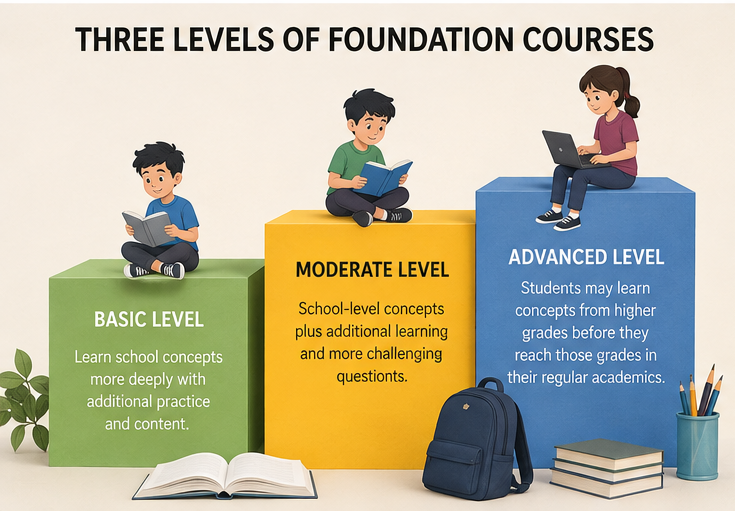
Foundation courses can be provided at different levels depending on how much additional learning is included. The three levels discussed here are Basic, Moderate and Advanced.
1. Basic Level
At the basic level, the course content is mainly aligned with the student's regular school academics. Students learn the concepts they are already studying in school, along with some additional content that helps extend their understanding. Because the course remains closely connected with academics, students can become familiar with foundation learning without feeling too much pressure. In simple terms, the Basic level means learning school concepts more deeply with some additional practice and content.
2. Moderate Level
At the moderate level, the course goes somewhat beyond the regular school curriculum. The fundamental concepts are still connected with academics, but students are introduced to additional content and more challenging problems. This gives them an opportunity to gradually improve their understanding and develop better problem-solving skills. In simple terms, the Moderate level means school-level concepts along with additional learning and more challenging questions.
3. Advanced Level
At the advanced level, students are introduced to content that is above their current grade level. For example, if a foundation course is being provided for Grade 6 students, the course material may include concepts from Grade 7 or Grade 8. Students therefore get an opportunity to learn advanced concepts earlier and practise questions based on them. In simple terms, the Advanced level means students may learn concepts from higher grades before they reach those grades in their regular academics.
Along with the course material, academies may also provide question papers following a pattern similar to IIT, JEE/NEET examination papers. Teacher orientation is also provided to help teachers understand the foundation material and how it should be taught.
How IIT, JEE/NEET Foundation Courses Benefit Schools Managements & Students
When foundation courses are properly planned and implemented, they can provide several benefits to students, particularly when they are introduced from Grades 6 to 9.
1. Early Conceptual Understanding of IIT, JEE/NEET foundation courses
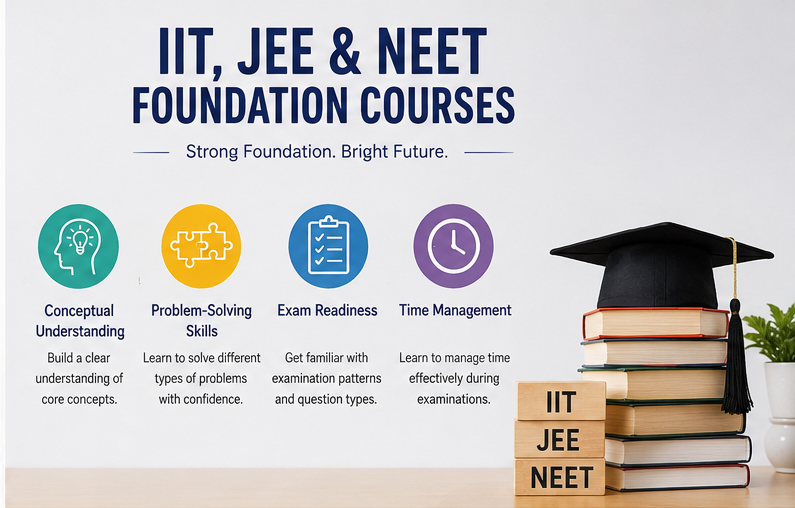
One of the main benefits of starting foundation learning at an early stage is that students begin to understand how concepts can be applied. Instead of studying a topic only for a school examination, students get opportunities to work with different types of questions and understand how the concepts they have learned can be used. They also get early exposure to formulas, concepts and different question patterns. This early exposure can help students become more familiar with these concepts before they eventually face competitive examinations.
2. Better Problem-Solving Skills
Regular practice is an important part of an IIT, JEE/NEET Foundation Courses. Students get opportunities to work on different types of problems, including tricky questions, puzzles, logical problems and formula-based questions. When students practise these types of questions regularly from an early stage, they get more time to think about a problem, understand it and find a way to solve it. This regular practice can help them develop their logical thinking and problem-solving abilities.
3. Reduced Examination Fear of IIT, JEE/NEET foundation courses
Another benefit of starting foundation preparation early is that students get opportunities to practise examination-style questions before appearing for actual examinations. As part of the foundation course, students can attend a number of practice examinations. Regular exposure to different types of questions and examination patterns can help students gradually become more comfortable with the examination environment. This early practice can help them approach examination-style questions with greater familiarity.
4. Improved Time Management
Time management is another important skill that students can develop through regular practice. As they solve different types of questions and practise question papers, they learn how to manage their available time, how to focus on questions and how to allocate time effectively for each question. Regular practice can help students improve their ability to complete a question paper within the given time.
Risks and Challenges of IIT, JEE/NEET Foundation Courses in Schools
IIT, JEE/NEET Foundation courses can be useful, but introducing them to young students also comes with certain challenges. Children already have regular academics, homework and other activities. When foundation preparation is added to their schedule, there needs to be a proper balance. If students are pushed too hard, the purpose of foundation learning can be affected.
1.Mental Stress
When young students have to manage their regular academics along with too many advanced concepts, terms, formulas and logical problems, they may feel mentally stressed. Students need enough time to understand what they are learning instead of feeling pressured to learn everything quickly. Foundation learning should give students an opportunity to understand concepts rather than making them feel that they have to remember everything at once.
2. Loss of Creativity
Foundation courses mainly concentrate on Mathematics and Science. If students spend too much time on these subjects, they may have less time for other activities such as sports, arts, creative activities and personal hobbies. Children need time for these activities as well, so schools need to maintain a proper balance between foundation preparation, academics and other activities.
3. Burnout
Too much pressure can sometimes make students lose interest in studying. A child may already be trying to manage regular school academics, and when foundation preparation and the expectations of school management and parents are added, the child may feel overloaded. The purpose of a foundation course should not be to make children feel that they are continuously under pressure. Students need an environment where they can learn and practise without feeling overwhelmed.
4. Rote Learning
Another concern is that students may sometimes be taught shortcuts without properly understanding the basic concepts. At some coaching centres, students may be encouraged to memorize shortcuts instead of understanding how and why a particular method works. For foundation learning, understanding the basic concept and core logic should come first rather than simply memorizing shortcuts.
How Can Schools Implement IIT, JEE/NEET Foundation Courses in a Better Way?
Schools naturally want their students to perform well in examinations. But good results should not come at the cost of making students feel constantly stressed. A foundation course should be planned in a way that allows children to learn, practise and understand concepts while continuing their regular academics. The aim should be to create a learning environment that is stress-free, creative and enjoyable, while still helping students build strong fundamentals.
1. Start with the Basics
The first step should be to make sure that students understand the basic concepts and core logic. Instead of immediately teaching examination shortcuts, teachers should first explain the concept clearly. The foundation course can be connected with the regular academic curriculum and then gradually introduce additional concepts. The focus should be on understanding first and shortcuts later, rather than expecting students to memorize methods without knowing the concepts behind them.
2. Make Classes Interactive
Children are more likely to take interest when learning is enjoyable and interactive. Foundation classes can include activities such as games, puzzles, questions and answers, group discussions, projects, practicals and other interactive sessions. Difficult Mathematics and Science concepts can be explained in simple ways so that students can understand them more easily. The goal should be to make children interested in learning rather than making them feel that foundation preparation is another burden.
3. Keep Homework Manageable
Extra homework can add to the pressure students already experience through their regular academics. Therefore, foundation-course homework should be kept short and manageable. Students should still have enough time for playing, sports, creative activities and their personal hobbies. A proper balance between study time and personal time can help children learn without feeling overloaded.
4. Give Proper Orientation to Teachers
Teachers play an important role in implementing a foundation course. School teachers may already have experience with regular academic teaching, but they may not be familiar with the particular foundation-course material and teaching method. Therefore, teachers should receive proper orientation about how the foundation material has been prepared, how the material should be taught, how the teaching schedule should be planned, how the foundation course is aligned with regular academics and how concepts should be introduced to students. When teachers understand the course properly, they can handle the foundation program more effectively along with regular academics.
What Should Parents Understand About Foundation Courses?
Parents may naturally have questions when their child's school introduces an IIT, JEE/NEET Foundation Courses. For parents who are hearing about these courses for the first time, the most important thing is to understand what the course includes and how it will fit into the child's regular academic schedule.
Parents should understand whether the course focuses on basic concepts, whether the learning is interactive, how much additional homework is given and whether students are getting enough time for other activities. The aim should be to ensure that children are learning concepts and developing problem-solving skills without feeling unnecessary pressure.
Conclusion
An IIT, JEE/NEET Foundation Courses for students from Grades 6 to 9 is an early preparation program that focuses on Mathematics and Science concepts, logical thinking and problem-solving skills. Starting this type of learning early gives students opportunities to understand concepts, practise different types of questions, become familiar with examination patterns and develop time-management skills.
At the same time, schools need to be careful about the pressure placed on young students. Regular academics, foundation preparation, homework, sports, arts, hobbies and personal time all need to be balanced. A good foundation program should therefore focus on strong basics, clear understanding, interactive learning, regular but manageable practice and proper teacher orientation.
Most importantly, learning should remain stress-free and enjoyable. The purpose of foundation learning should be to help children understand concepts, build confidence and develop better problem-solving skills—without taking away the joy of learning.
Pingback: Two-Wheeler Driving Schools in Hyderabad: Safe Learning Guide